


Hello everyone. My previous article analyzed the volume shares of companies participating in the centralized procurement of digestive interventional devices; Micro-Tech’s performance was truly impressive, ranking first in 12 out of the 23 product categories. Yet, while this success is gratifying, the high market share held by imported brands in categories like stents presents a contrasting reality. Ranking first in volume is certainly a source of pride, but the interim report also reveals the company’s strategic foresight and proactive planning regarding the industry landscape—hinting at a shift toward transformation.
Notably, while the report mentions “transformation” only four times, it references “centralized procurement” 18 times and “overseas markets” 40 times.
1. Key Operating Figures
In the first half of the year, Micro-Tech recorded revenue of RMB 1.73 billion (RMB 1,727,947,419.23), a year-on-year increase of 10.39%; net profit attributable to the parent company was RMB 303 million (RMB 303,425,747.12), a year-on-year decrease of 16.50%. While the profit appears to have declined, the actual cause was the appreciation of the RMB during the period, which resulted in an exchange loss of RMB 83 million upon the translation of foreign currency asset exposures; excluding the impact of exchange losses and income tax, the net profit attributable to the parent company would have been RMB 373 million, representing a year-on-year increase of 16.41%.
2. Revenue Breakdown
2.1 By Region
Domestic revenue saw only slight growth, while the three overseas business lines grew by 15%–20%+.
Domestic revenue stood at RMB 634 million, while overseas revenue reached RMB 1.094 billion (up 20%), accounting for 63% of the total.
Figures at the parent company level:
- Asia-Pacific region: RMB 721 million (+7.20%), comprising RMB 556 million from the domestic market (growth of only 2.25%) and RMB 164 million from overseas Asia-Pacific markets (+28.18%);
- Americas region: RMB 392 million (+15.07%);
- EMEA region (including CME): RMB 506 million (+21.88%).
Subsidiary Kangyou Medical recorded revenue of RMB 106 million, a year-on-year decline of 20.39%; it was the only segment to underperform, although its overseas revenue grew by 36% year-on-year.
2.2 By Product
Endoscopy consumables account for 80% of revenue; visualization products show a gross margin of 3.98%.
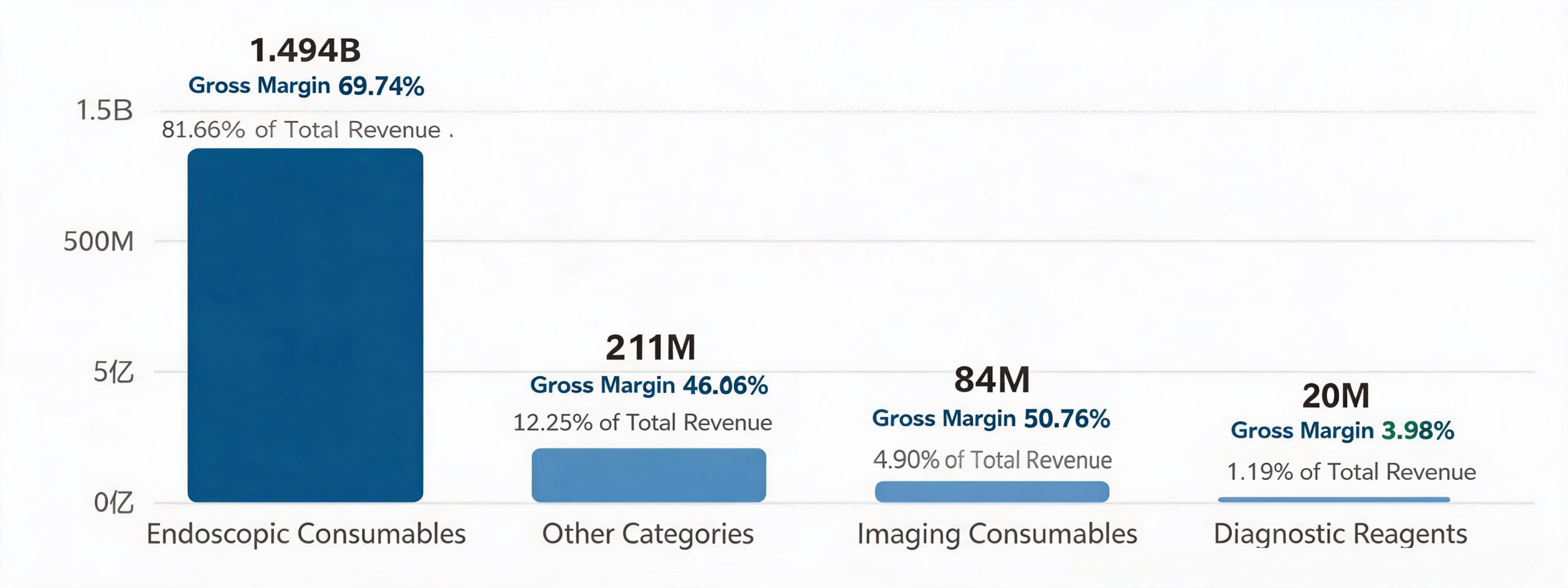
- Gross Margin: The gross margin for core business operations stands at 65.13%—a robust figure given the backdrop of centralized procurement across domestic provinces.
- Endoscopic Consumables: Revenue of RMB 1.404 billion (accounting for 81.66% of core business revenue) with a gross margin of 69.74%, outperforming industry peers.
- Oncology Interventional Products: Revenue of RMB 0.084 billion (4.90% of the total), with a gross margin of 50.76%. A comparison with H1 of the previous year reveals that this was the only product category to experience a year-on-year decline (-26.07%).
- Visualization Products: Revenue of RMB 0.020 billion.
- Other Products: Revenue of RMB 0.211 billion, with a gross margin of 46.06%.
3.3 By Customer and Sales Model
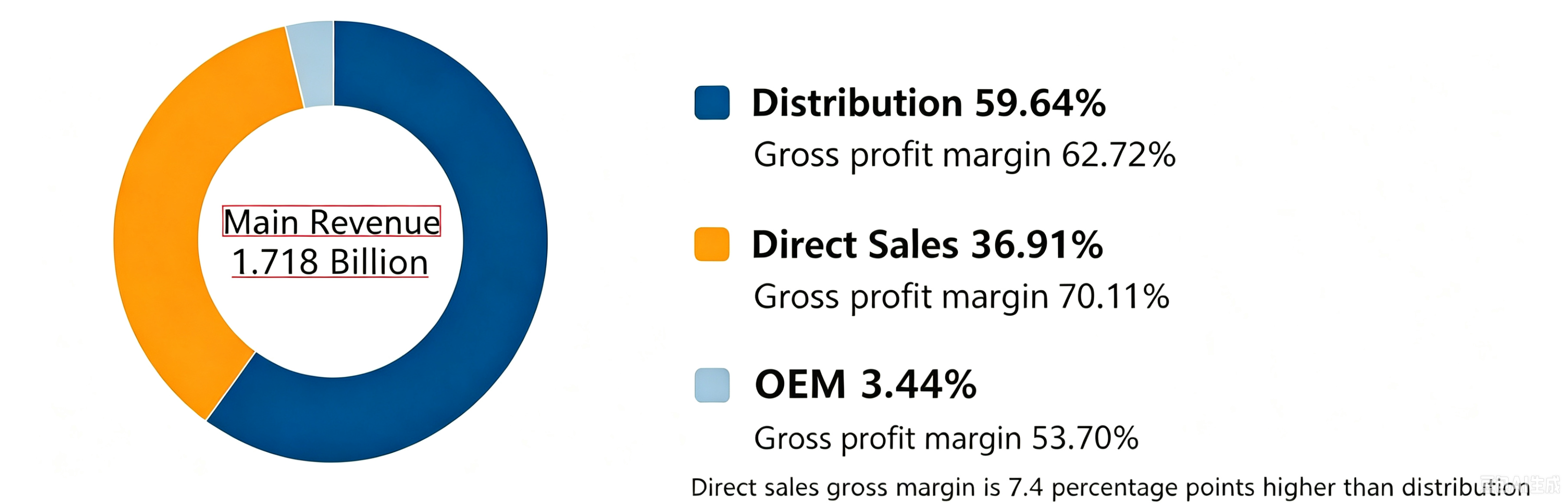
Distribution model breakdown: Distributorship sales totaled RMB 1.026 billion (59.64% of total; gross margin: 62.72%); direct sales totaled RMB 0.635 billion (36.91%; gross margin: 70.11%); and OEM sales totaled RMB 0.059 billion (3.44%; gross margin: 53.70%).
Channel landscape: Domestically, the company has partnered with multiple large-scale distributors, covering hospital terminals nationwide. Internationally, it has established wholly-owned subsidiaries in the US, Germany, the UK, France, the Netherlands, Japan, Portugal, and Switzerland to serve as strategic footholds; these eight overseas subsidiaries, along with a manufacturing center in Thailand, have already commenced supply operations.
In the first half of the year, the company also finalized the acquisition of three product lines from the US-based CONMED, directly inheriting established end-customer relationships and localized operational capabilities.
3. Observations
Based on the public letter from Micro-Tech’s (Nanwei’s) chairman, the company initiated its upgrade and transformation strategy some time ago. R&D is the key driver for its overseas operations.
3.1 For instance, the sales proportion of Micro-Tech’s innovative products has steadily increased over the past two years; in the first half of the year, they accounted for 10% of total revenue, marking a year-on-year growth of over 40%. Notably, the disposable endoscope business has entered a phase of healthy growth, with outstanding overseas sales performance—achieving 60% year-on-year growth in the Americas and over 50% in Europe. This growth is further bolstered by the ramping up of sales for several new products, such as vacuum drainage stents for treating gastrointestinal fistulas, three-arm clips, and cold snares (Nitinol).
3.2 Take, for example, the currently very low gross margins for its visualization products:
- 2024: 50.59%
- 2025: 14.08%
- First half of 2026: 3.98%
Whether these margins recover in the second half of the year depends on domestic centralized procurement pricing and the volume of overseas sales; consequently, the gross margin of Micro-Tech’s disposable endoscopes should not be used as a benchmark for the industry.
This shows the gross profit margin for Pusheng’s products; the company specializes in disposable endoscopes and focuses primarily on overseas markets (accounting for 70.97% of revenue).
Link: (Pusheng) Another disposable endoscope company pursues an IPO—details inside.
Once volume hits the inflection point for scale, the gross margin should climb; let’s re-evaluate the situation in 2027.
3.3. The 7th batch of national centralized procurement (VBP) for gastroenterology interventional devices: The price submission on September 10 marks the final showdown—how will the results for imported products turn out?
In the 6th batch (urology intervention), Boston Scientific won bids in two categories and Cook Medical in one. In the volume reporting phase for this 7th batch (gastroenterology), Micro-Tech secured the top spot in volume reporting for 12 out of the 23 categories and appeared in the top-five rankings 21 times. Reported volume for hemostatic clips reached approximately 5.337 million units (49.0% of total demand for the product); oral biliary-pancreatic visualization catheters accounted for 61.75%, and esophageal stents for 56.92%; hot biopsy snares totaled 1.192 million units (26.7%). In the ERCP category, several imported brands ranked ahead of Micro-Tech.
The rules for the 7th batch have changed again: on one hand, measures to curb cutthroat internal competition have become more pragmatic; on the other, competition remains fierce in certain categories. There were 71 applicants for stone retrieval baskets, 54 for hemostatic clips, and 46 for hot biopsy snares.
ZRHmed: Your Direct Path to Higher Margins in Gastroenterology Consumables
As the 7th national VBP for gastroenterology interventional devices approaches, price pressure continues to squeeze margins across the distribution chain. For distributors and healthcare providers, the key to sustaining profitability lies not only in volume, but in where you sit in the supply chain.
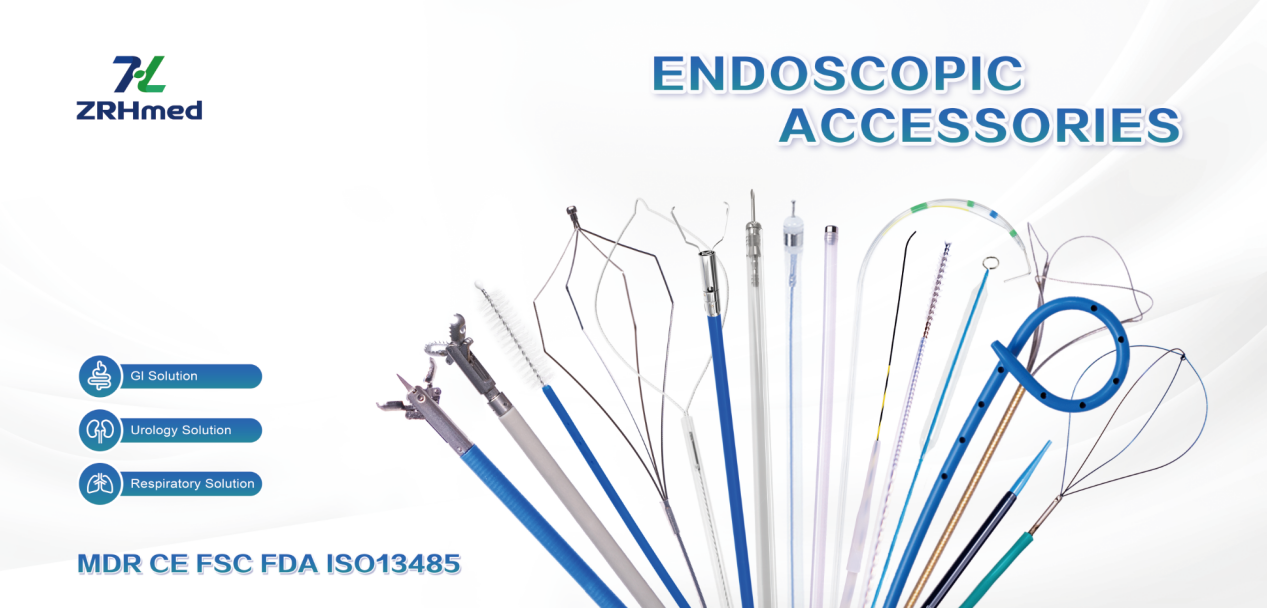
ZRHmed (Jiangxi Zhuoruihua Medical Instrument Co., Ltd.) offers a direct answer. As a Chinese manufacturer specializing in endoscopic consumables, ZRHmed provides a full portfolio of gastroenterology products – including biopsy forceps, polypectomy snares, hemostatic clips, sclerotherapy needles, spray catheters, cytology brushes, guidewires, stone retrieval baskets, and nasal biliary drainage catheters.
Unlike trading companies or multi-layer distributors, ZRHmed offers Tier-1 distribution partnerships with direct factory access. This means:
In a market where every percentage point of margin matters, ZRHmed gives you the advantage of direct manufacturer partnership – not just a lower price, but a more profitable business model.
Partner with ZRHmed. Become a Tier-1 distributor. Earn more.
Contact us today to discuss exclusive distribution opportunities in your region.
Post time: Sep-15-2026