


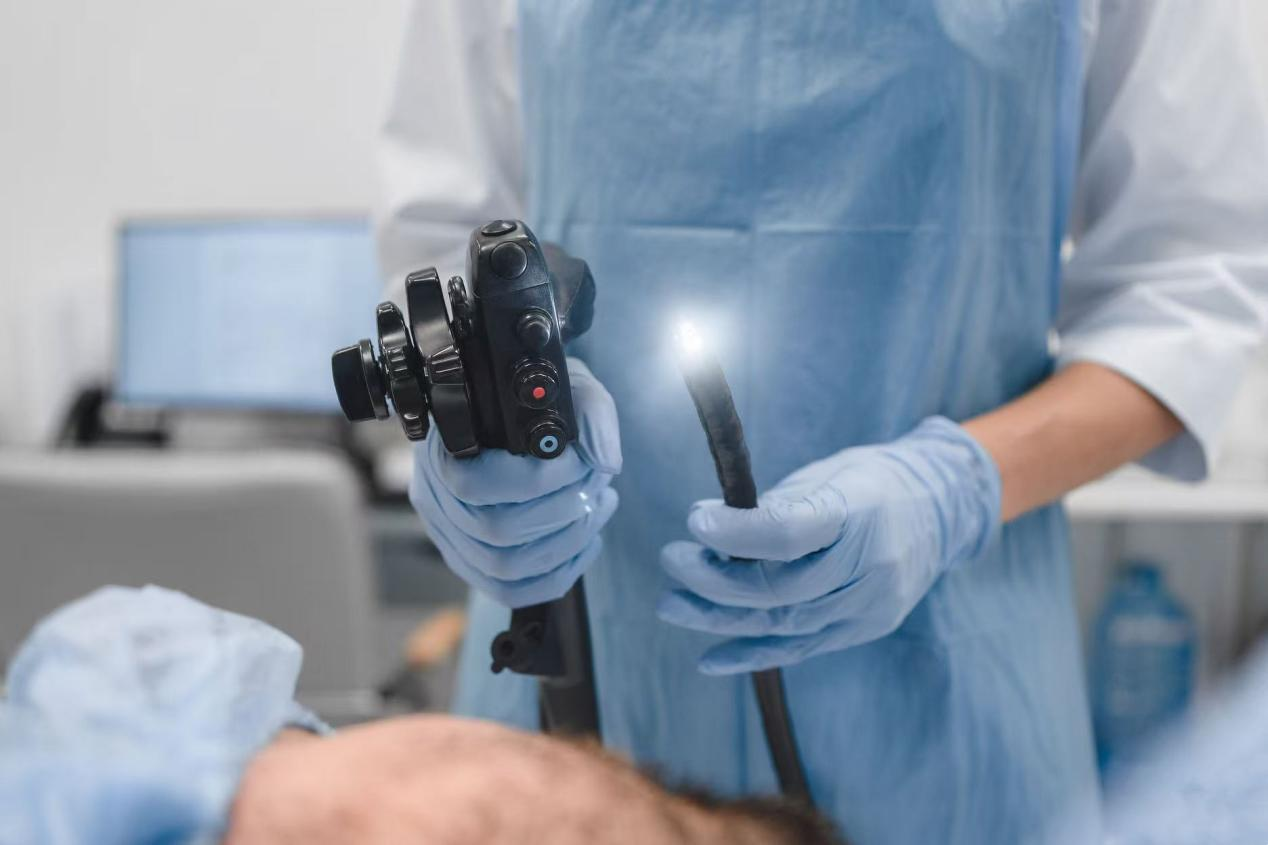
Anyone who has had a gastroscopy remembers that tube.
It goes down the throat, and on the screen appear your own esophagus, stomach wall, pylorus. For the past decade or so, that tube has had essentially one brand: Olympus.
A Japanese company. Founded in 1919 as a microscope maker, it later turned gastroscopes, colonoscopes, and bronchoscopes worldwide into its own private preserve. On the equipment lists of gastroenterology departments in Chinese hospitals, this name was once written until it became numbingly familiar.
Now, this name is declining.
Not a slogan. It’s the seven percentage points lost each year on hospital procurement lists.
First, Look at These Figures
In the first three quarters of 2025, in China’s hospital-end procurement of flexible endoscopes, Olympus still sat in first place, with a 43.4% share. But year-on-year, it dropped 7 percentage points.
One year, seven points. The global king of flexible endoscopes has had a chunk of its lead in China shaved off. Under the same methodology, domestic brand SonoScape ranked third, with an 8.6% share, up 4.1 percentage points in one year. The gain aligns precisely with Olympus’s loss.
Now look at the other side: rigid endoscopes used in surgery. Mindray holds a 12.6% share, ranking second in China. Olympus has 8.61%, falling to third.
In plain language: on the operating room side, Chinese companies have already pushed Olympus behind them. On the gastroscopy and colonoscopy side, the Japanese company is still seated, but the chair gets a little shorter every year.
Looking back several years: five overseas giants — Olympus, Fujifilm, Karl Storz, Hoya, and Stryker — once collectively took about 90% of China’s endoscope market. By the first half of 2024, under bidding and tender data, that had fallen to about 60%.
Why Could This Tube Hold China Hostage for Decades?
A gastroscope looks like just a flexible tube. What’s truly valuable is hidden in the bending section and the lens. The tube must navigate turns in the esophagus, neither perforating the mucosa nor failing to capture millimeter-level lesions clearly. Optics, CCD, bending traction, air/water insufflation, biopsy channel — the entire set is locked together.
The feel that doctors have built up over a decade of use is locked in with it. So hospitals didn’t dare switch. Switching equipment isn’t switching a monitor; it’s switching a department’s operating habits, consumables catalog, and repair hotline.
In the past, the key to this lock was in Tokyo. Waiting for parts, waiting for engineers, waiting for quotes. This is what monopoly really looks like: it’s not that you’re not allowed to buy — it’s that you don’t dare not to.
Where China Is Strong — Where the Japanese Can’t Catch Up
Primary-level hospitals switch first: In 2024, SonoScape’s share in digestive endoscope procurement at secondary and lower-level hospitals surpassed Fujifilm, ranking first among domestic brands and second overall.
The rigid endoscope side has already flipped: Mindray ranks second in rigid endoscopes in China; Olympus is third. The combined share of domestic brands was approximately 46% in the first three quarters of 2025.
New products are no longer just following: China’s first domestic endoscopic ultrasound (SonoScape), the world’s first 4K dual-fluorescence system (OptoMedic), and 4K 3D fluorescence (Mindray) are already in hospitals.
Maintenance and price: When domestic equipment breaks, engineers are in the same city; Japanese equipment often requires an overseas parts process. Downtime is the hidden cost hospitals are calculating.
Beginning to go abroad: Tiansong Medical and Reborn are entering markets in Japan, Germany, and the US. In 2023, Chinese manufacturers drove the volume for single-use flexible ureteroscopes with 150,000 units sold.
A Few Things That Need to Be Said Clearly
Flexible endoscope number one is still Olympus today. Rigid endoscope number one is still Germany’s Karl Storz today. These two statements are not dodged.
But the trend doesn’t look at who is still seated — it looks at who is giving up the seat. Olympus’s flexible endoscopes are losing seven points a year. This is not emotion; it is procurement data.
In the past, Chinese people queued for gastroscopies, and the tube was Japanese. Now, on the alternatives column of Chinese hospital procurement lists, there are Chinese names.
About ZRHmed – Supporting the Domestic Endoscopy Ecosystem
The shift from Olympus and other overseas giants to domestic brands is not only a story about main units. Every gastroscopy, colonoscopy, and endoscopic procedure also depends on a full set of precision disposable accessories.
ZRHmed (Jiangxi Zhuoruihua Medical Instrument Co., Ltd.) is a Chinese manufacturer of disposable endoscopic consumables for gastroenterology and endourology. Our portfolio includes:
- Biopsy forceps
- Polypectomy snares
- Hemostatic clips
- Injection needles
- Guidewires
- Stone retrieval baskets
- Cytology brushes
- Nasal biliary catheters
- Sphincterotome
- UAS with suction
- Urinary Stone Basket
- Urology Guidewire
Contact us to discuss Tier-1 distribution opportunities in your region
Post time: Nov-03-2026